Ensuring our district receives its fair share of federal resources is one of my top priorities. This year, I’m proud to be bringing home more than $34 million for important local initiatives as part of the Community Funding Project process. Learn more about these projects below:
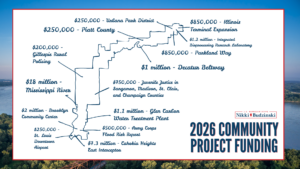
Fiscal Year 2026
- $2 million for the Brooklyn Community Center Project: The funding will be used by the Village of Brooklyn, Illinois, to revitalize a historic building located on Route 66, “The Skating Rink,” into a multifunctional space for community activities.
- $1 million for the Decatur-Macon County Beltway Northeast Connector Design Engineering: The funding will be used for design engineering of the next segment of the Beltway Northeast Connector in Decatur.
- $250,000 for Piatt County Building Improvements: The funding will be used for the installation of energy efficiency measures, bathroom renovations, and building rehabilitation activities of buildings owned by Piatt County, Illinois, that are not used for conducting the general business of government.
- $850,000 for the Illinois Terminal Expansion Project: The funding will be used to purchase two parcels of land from the City of Champaign to expand the Illinois Terminal.
- $1.2 million for the Integrated Bioprocessing Research Laboratory Expansion at the University of Illinois at Urbana-Champaign: The funding will be used for the construction of an expansion to the Integrated Bioprocessing Research Laboratory.
- $250,000 for the Urbana Park District’s Prairie and Weaver Park Site Rehabilitation: The funding will be used to improve restrooms/day-use facilities, utilities, grading, drainage, landscaping, parking, and lighting at Prairie and Weaver Parks.
- $850,000 for the Parkland Way Reconstruction led by the Champaign Park District: The funding will be used to renovate the Parkland Way roadway into a complete street with multimodal transportation capabilities, while also creating a direct connection to the underserved neighborhood of Garden Hills.
- $250,000 for St. Louis Downtown Airport Aircraft Rescue Firefighting Apparatus and Snow Removal Equipment Acquisition Project: The funding will be used for the acquisition of a new Index B Aircraft Rescue and Firefighting (ARFF) apparatus and specialized Snow Removal Equipment (SRE), both of which are essential to the safety, functionality, and economic sustainability of the St. Louis Downtown Airport in Sauget, IL.
- $7.3 million for the Cahokia Heights East Interceptor: The funding will be used for construction of interceptor sewers to modernize the city’s sanitary sewer service and reduce sewage overflows.
- $500,000 for the U.S. Army Corps of Engineers General Reevaluation Report for East St. Louis & Vicinity: The funding will be used to initiate a General Reevaluation Report (GRR) within an approximate 86,000-acre study area that contains eleven communities, 126,745 residents, $8 billion in property value, over 46,000 structures, 167 critical structures, and 8,700 acres of prime farmland to investigate structural and non-structural approaches to solving recurring flood risk challenges in the study area.
- $1.1 million for the Village of Glen Carbon Drinking Water Plant: The funding will be used for the construction of a new 3,000,000-gallon-per-day water treatment facility.
- $750,000 for the TASC Juvenile Justice System Specialized Case Management and Wraparound Services: The funding will be used to provide a program of services which identifies and meets the treatment needs of juvenile drug-dependent and alcohol-dependent offenders in Sangamon, Madison, St. Clair, and Champaign counties to reduce recidivism and help impacted youth become thriving citizens in their communities.
- $18 million for Navigation and Ecosystem Sustainability Program: The funding will be used for several Upper Mississippi River improvement efforts, including navigation improvements and aquatic ecosystem restoration.
- $200,000 for Gillespie Rural Policing Technology: The funding will be used for street cameras and accompanying hardware to address multiple local security-related needs.
Fiscal Year 2024
- $120,000,000 for the Navigation and Ecosystem Sustainability Project (NESP) on the Upper Mississippi and Illinois Rivers
- $5,000,000 for the East Alton Water Treatment Facility Upgrades
- $1,607,182 for Springfield’s CAP 1908 Innovation Co-Working Center
- $1,059,097 for Alton Workforce Housing
- $1,000,000 for East St. Louis’s Youth Workforce Development Training Center
- $1,000,000 for Springfield’s Pillsbury Mills Redevelopment Project
- $1,000,000 for the Bethalto Boys and Girls Club Clubhouse
- $963,000 for the University of Illinois Police Champaign-Urbana Real Time Crime Center
- $850,000 for Champaign’s Garden Hills Revitalization Project
- $850,000 for Wood River’s 9th Street Detention Pond
- $800,000 for Staunton’s Force Main Project
- $500,000 for Decatur’s EnRich Educational Campus Housing Project
- $500,000 for the Macoupin Center for the Developmentally Disabled
- $500,000 for East St. Louis’s Parsons Place Preservation Project
- $500,000 for Village of Pawnee Water Main Replacement
Legislative Priorities & Accomplishments
Anti-Corruption Agenda
Our democracy works best when elected officials are accountable to the people they serve – not secret donors or special interests. That’s why I was proud to introduce legislation to ensure public servants aren’t profiting on inside information. The PREDICT Act (Preventing Real-time Exploitation and Deceptive Insider Congressional Trading Act) is a bipartisan bill aimed at banning members of Congress, their families, and senior federal officials from trading on political prediction markets.
In addition to my legislation to prevent insider trading amongst government officials, I’ve also backed an anti-corruption agenda to get dark money out of politics, hold politicians accountable, and bring ethics back to Washington, D.C. Some of the initiatives I’ve been calling for include:
- Citizens Over Corporations Amendment (Rep. Joe Neguse) – Amendment to the Constitution that would overturn the Citizens United decision.
- Presidential Accountability Amendment (Rep. Joe Morelle) – Amendment to the Constitution to ensure that presidents and other top officials in government are not immune from criminal prosecution.
- Restore Trust in Congress Act (Rep. Chip Roy and Rep. Seth Magaziner) – Prohibits all Members of Congress, their spouses, dependent children, and their trustees from owning, buying, or selling individual stocks, securities, commodities, or futures.
- High Court Gift Ban Act (Rep. Jamie Raskin and Rep. Alexandria Ocasio-Cortez) – Bans SCOTUS justices from receiving gifts worth more than $50 in a single instance or $100 over the course of a year, aligning their ethical standards to those that Members of Congress abide by.
- SCOTUS Ethics, Recusal, and Transparency Act (Rep. Hank Johnson) – Requires SCOTUS justices to adopt and follow a binding, enforceable code of ethics.
- DISCLOSE Act (Rep. Pappas) – Requires organizations spending money in elections – including super PACs and dark money groups – to disclose donors who have given $10,000 or more in an election cycle.
Affordability Agenda
The cost of living is way too high. Whether its groceries, healthcare, utility bills, or childcare, working families are being squeezed from all sides. In my position as Vice Chair for Policy of the New Democrat Coalition, I’ve rolled out a comprehensive affordability agenda to tackle these everyday costs and give hardworking Americans some much-needed breathing room:
- Lower grocery costs by taking on President Trump’s tariffs and supporting more competition in the grocery industry.
- Cut red tape and modernize permitting to build four million new homes over the next decade.
- Establish a national paid family and medical leave program.
- Extend the ACA tax credits and reverse Republican Medicaid cuts.
- Protect patients from surprise medical bills and stop aggressive medical debt collection.
- Fast track new and innovative energy sources to drive down utility costs and boost economic development.
- And more!
Workers
I’ve dedicated my career to fighting for working people, and as the granddaughter of a painter and a public school teacher, I know firsthand that union membership is a ticket to the middle class. Here in Congress, I’m proud to serve as Vice Chair of the Labor Caucus where I’m leading the fight to protect the right to organize, improve wages and working conditions, and build an economy that puts working families first.
In 2025, unions faced some of their most significant challenges in recent years. In response, here’s how I took action:
- Helped force a vote on and pass the Protect America’s Workforce Act, which would restore collective bargaining rights to federal workers who had them stripped away by President Trump.
- Re-introduced bipartisan legislation to protect union rights for public safety officers, allowing them to collectively bargain for wages, hours, and negotiations.
- Cosponsored bills to support federal workers during the government shutdown, including backpay for federal contractors and protections for families and federal workers.
- Met with furloughed federal workers and rallied with unions (Illinois AFL-CIO, AFSCME, AFGE) to highlight the toll of shutdown politics on union workers and public services.
One of the first bills I was proud to introduce was the LEAP Act, a bipartisan bill to expand workforce development opportunities by providing federal tax incentives to businesses that hire apprentices. These training programs are a proven way to fill the job skills gap and get folks ready for careers in growing industries.
I’m focused not only on expanding the skilled trades workforce, but also on protecting the jobs that sustain our communities – including steel jobs. When U.S. Steel threatened to shut down Granite City Works in our district, I joined the men and women of the United Steelworkers to prevent hundreds of workers from being laid off. After months of pressure, U.S. Steel finally agreed to restart the blast furnace at this plant – a victory that shows the power of collective action. But the fight isn’t over, and I’m continuing to push to see the long-term investments and assurances Granite City deserves.
Postal Service
For many Central and Southern Illinoisans, the Postal Service is a lifeline. Whether it’s how you get your prescriptions and paychecks or how you pay your bills and send in your ballot, it’s critical that you can get your mail when you need it. As on-time delivery rates worsen, rural post offices close, and the future of USPS falters, we need solutions to protect hardworking postal employees and ensure reliable service for our communities.
I’m proud to be a co-founder and co-chair of the bipartisan Congressional Postal Service Caucus to tackle these issues head-on.
In January, three of my priorities to strengthen USPS passed the House of Representatives! These provisions would address top issues impacting mail delivery for rural communities, including USPS plans to limit the number of times mail is picked up from rural post offices, to consolidate processing facilities, and to close local post offices. I’m continuing to push for meaningful congressional action to address the decades-long challenges facing the USPS—chief among them keeping costs low, improving service, and protecting our postal workers. In March, I joined NewsNation to highlight the work I’ve been doing to advance these priorities and deliver real results.
Veterans
I’m honored to serve as Ranking Member of the House Veterans’ Affairs Subcommittee on Technology Modernization. That means I get to lead in crafting policies to make VA’s systems and processes work better for our nation’s veterans.
To that end, I couldn’t be prouder that my first bill to become law is one that I introduced to help VA incorporate veterans feedback. This legislation would codify VA’s Veterans Experience Office, ensuring that veterans’ voices are front and center and that their insights can lead to real reforms.
A number of other bills I’ve introduced to support veterans are also working their way through the legislative process:
- Passed House – Edith Nourse Rogers STEM Scholarship Opportunity Act. This bipartisan bill would help veterans pursue degrees in science, healthcare, and technology.
- Passed House – Health Professionals Scholarship Program Improvement Act. This bipartisan bill would address staffing shortages at the Veterans Health Administration by streamlining the pathway for participants in VA’s Health Professionals Scholarship Program (HPSP) into full-time roles at VHA.
- Passed House – Clear Communication for Veterans Claims Act. This bipartisan legislation would simplify the language used by the Department of Veterans Affairs (VA) in written communications, making it easier for veterans to access the benefits they’ve earned.
- Passed House – Improving VA Training for Military Sexual Trauma (MST) Claims Act. This bipartisan bill would improve the VA’s claims process to ensure that it does not retraumatize MST survivors.
- Passed Committee – VA Mental Health Outreach and Engagement Act. This bipartisan bill would expand VA’s outreach to veterans about mental health services.
Agriculture
Central and Southern Illinois is home to some of the most productive farmland in the world. As a member of the House Agriculture Committee, I’m fighting for policies to support the family farmers I represent and ensure they have the resources they need to feed and fuel our nation.
Here are some highlights:
- Passed House – Nationwide Consumer and Fuel Retailer Choice Act – bipartisan bill to codify year-round E15, creating more markets for Illinois corn growers and lowering costs for consumers at the pump.
- New Producer Economic Security Act – bipartisan legislation to help young and beginning farmers access land, capital, and markets.
- BASE Act – bipartisan bill to update base acres and ensure the farm safety net accurately reflects what farmers grow today.
- Local Farmers Feeding Our Communities Act – bipartisan legislation to help farmers sell what they grow to local food banks and schools.
- Biobased Materials Investment and Production Act – bipartisan legislation to incentivize investment in biomanufacturing, creating more markets for farmers.
Healthcare
In their so-called “One Big Beautiful Bill Act,” (OBBBA) President Trump and Republicans in Congress enacted the deepest cuts to Medicaid in American history and ended critical tax credits that make marketplace coverage affordable. 15 million Americans will lose their health insurance as a result.
As they lose Medicaid funding and have to take on more uninsured patients, rural hospitals will be stretched to the brink and many will close. Republicans created a “Rural Health Transformation Fund” to put a bandaid on this situation, and while this $50 billion program doesn’t even begin to cover the $137 billion in rural Medicaid cuts in the OBBBA, I am fighting to make sure Illinois gets its fair share of this funding. I led the Illinois delegation in a letter to the Trump Administration urging them to deliver the resources our state needs.
The truth is, our rural hospitals have been struggling long before the OBBBA became law. That’s why I’ve introduced legislation to address underlying financial strains and provider shortages that plague many rural health systems like my Save America’s Rural Hospitals Act and my Rural America Health Corps Act.
I’m fighting tirelessly to restore the Affordable Care Act enhanced premium tax credits – because without these subsidies, millions of Americans have seen their health care premiums double or even triple. On the topic of affordability, I’m also proud to support the Pharmacists Fight Back Act – bipartisan legislation that would help bring down the cost of prescription drugs by reigning in predatory Pharmacy Benefits Managers. I’ve also cosponsored the Lowering Drug Costs for American Families Act. This comprehensive legislation would expand Medicare’s ability to negotiate lower drug prices, cap annual out-of-pocket drug costs, and undo harm caused by President Trump’s Big, Ugly Bill. Additionally, I’ve introduced the Blocking Act to increase competition in the pharmaceutical industry and lower prices for patients.